Fish Moli for Fathers’ Day


It’s Fathers’ day. Pip gave Mark a lovely card, a hedgehog feeder and a box of Maltesers. Mum and Dad never made a fuss of these occasions but they always seemed pleased if you acknowledged it in some way, however small. Not phoning was the worst you could do on the day. If you left it until late in the evening, you might get a disappointed voice on the other end, just enough to make a point, and then we could move on to other subjects. I hope I could convey my appreciation of them throughout the year but it’s always nice to have another day to celebrate them. Essentially, Mum and Dad wanted us to save our money rather than fritter it away on luxuries such as hedgehog feeders. Pip loves creating things so (apart from buying the box of chocolates, which it transpires she got at a heavily reduced price because I didn’t give her the £2.50 for the school Fathers’ Day sale this week) we’ll let her off.

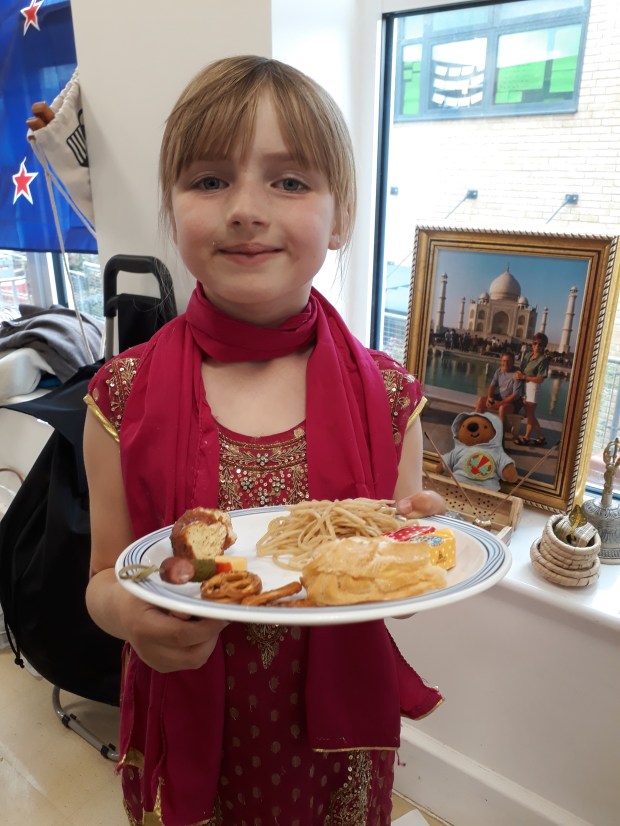
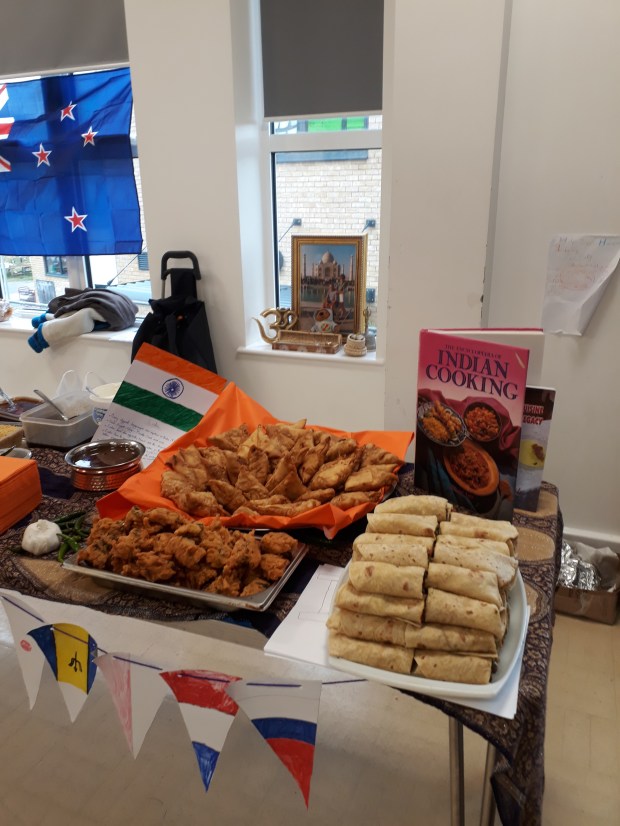
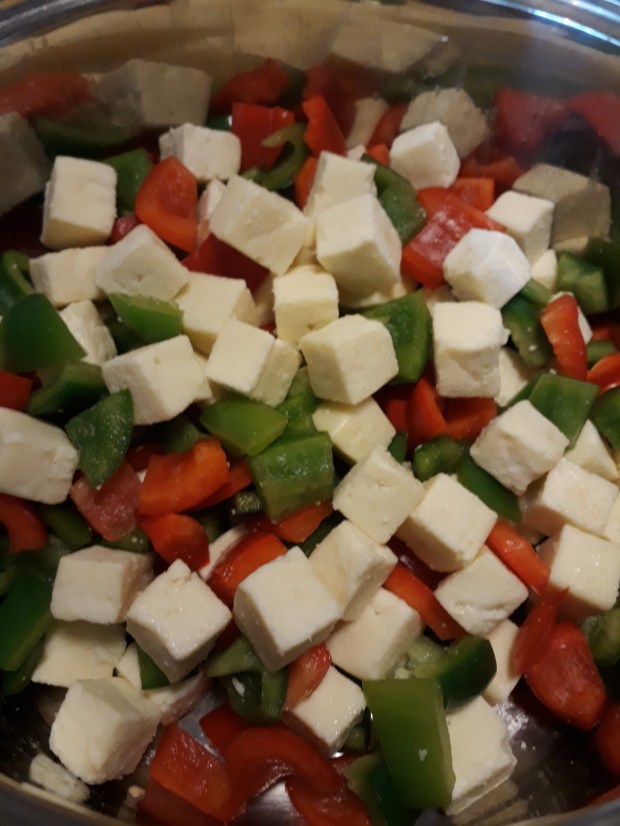
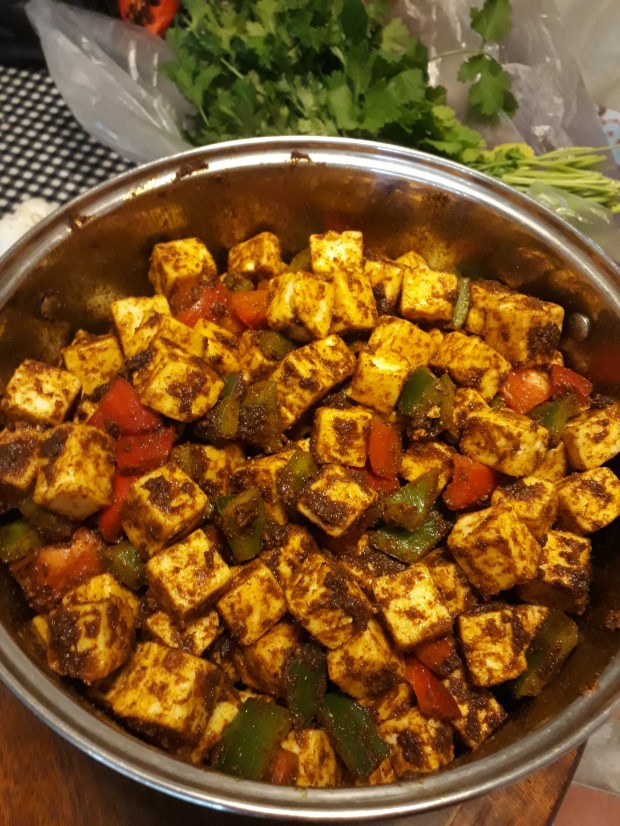
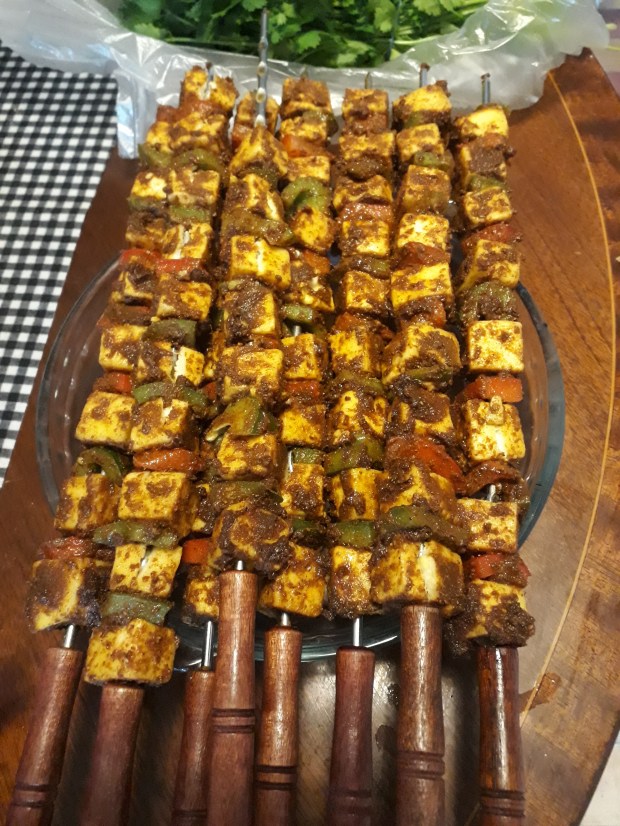
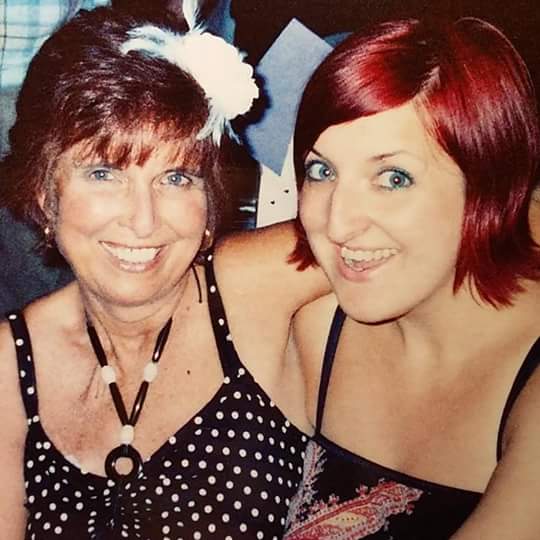
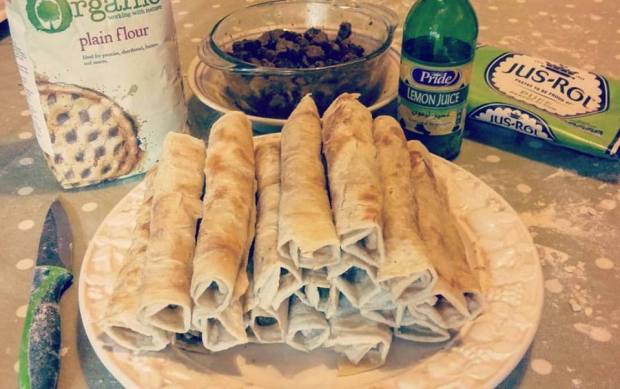
Even though we should be thinking of our fathers, I’ve been thinking about Mum a lot recently. It’s almost two and a half years since she died and yet I haven’t got anywhere close to fulfilling her recipe legacy. This week I made Karti Kebabs for Pip’s school’s International Evening but I substituted meat for paneer as we’re trying (and often failing) to be more veggie because of the terrible impact the meat industry has on the climate. I was rather pleased with how they turned out and didn’t miss the meat at all; tangy and spicy with the Madras kebab paste as usual but also with an unexpected crunch from oven baking the marinated paneer. Together with crisp red onions and a sluice of lemon before rolling, they were really rather good (even if I do say so myself!).

screenshot_20190613-192858_instagram

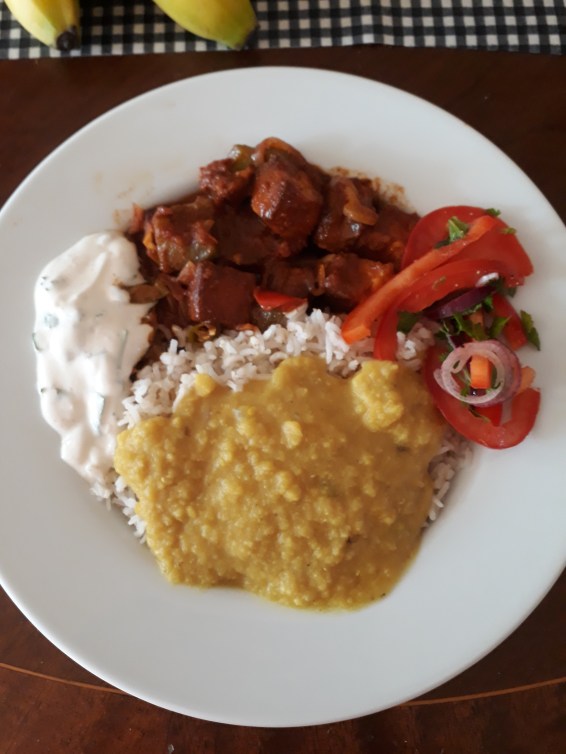
So this weekend we’ve been eating the Madras paneer leftovers in all sorts of ways (I made way too much for the 40 rotis I had…). First I made a batch into a vegetable curry adding bell peppers and chili to make it spicier. I also made some Tarka Dhal because I bought a huge bag of lentils when I went to Southall for the big shop.

20190614_171811

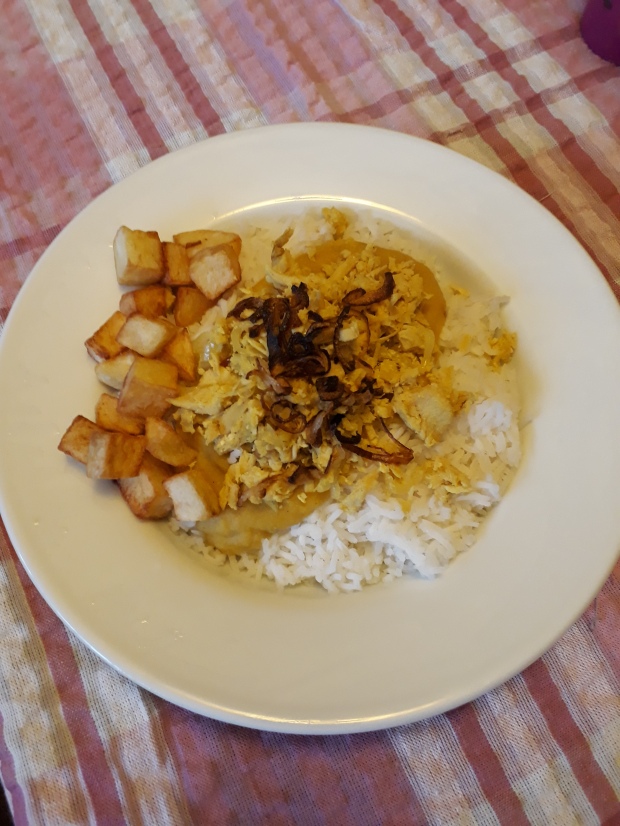
Then I ran out of rice so made a cous cous bowl using porcini mushroom stock to soak the grains and adding sliced red onions, barberries and sultanas to make it a sort of Middle Eastern affair. This was also a success! The paneer has stayed firm at the edges but has lost its crispness so it really does taste like chicken.

20190613_201422

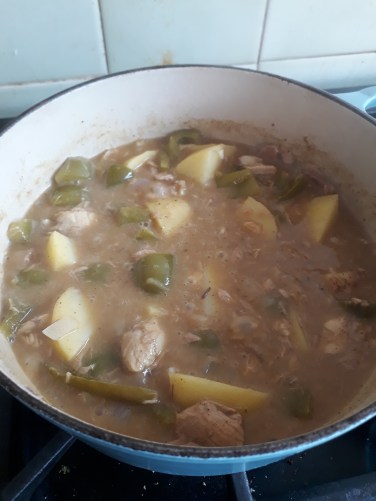
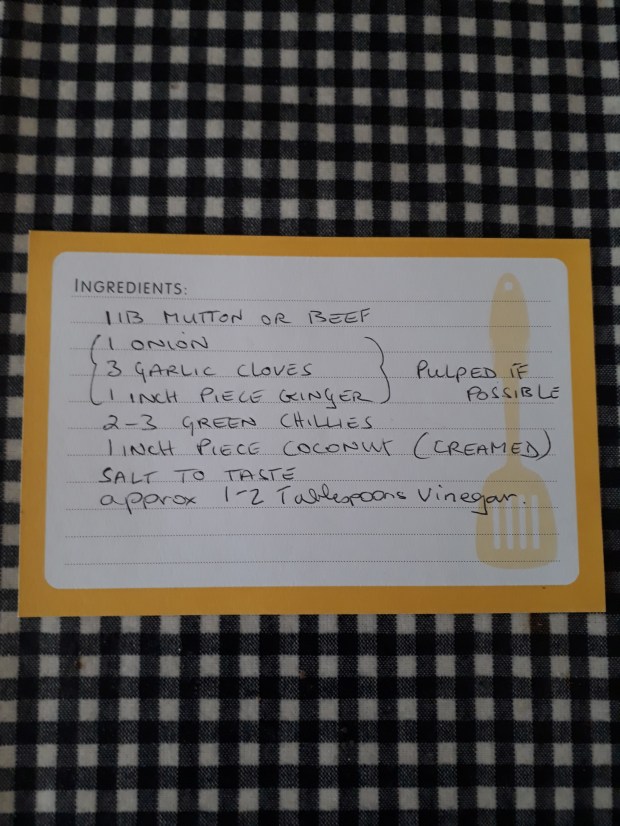
Today, the paneer has all gone but I still fancied something spicy and tangy and only had tinned fish to hand so I followed Mum’s Moli recipe, which calls for meat or fish. I’m using tuna and mackerel just to make it go further. I remember Mum making tuna curries and Moli made from a cheeky tin from time to time but the best version is with mutton and, yet, she would only really make it as an afterthought when the meat was left over from a bigger meal the day before. One of the delights of this recipe is that it needs a piece of creamed coconut, which I always keep a box of for emergencies in the fridge, like Mum used to. A little chunk of this goes a long way but, when I was young, I never understood why the box always seemed to be there, defying the use-by-date and looking retro and exotic with its palm leaves and azure sea. It used to sit beside the sturdy box of Atora Suet, a stalwart tin of ghee and myriad jars of mustard and horseradish.

20190616_152639-1

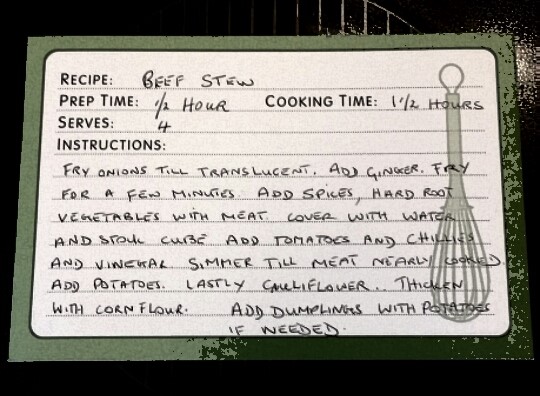
The other powerful ingredients in a Moli are ginger and vinegar: classic Anglo flavours. What these create is a tangy, sharp, moreish stew, pale in colour but strong in its warming, medicinal effect. I tend to make it go further by adding a tin of coconut milk, more vinegar and, today, some bell peppers because I still have loads from the big shop. This has made it soupier – like the classic Moli or Molee but unlike Mum’s, which was thicker and more concentrated. I prefer hers any day of the week even if I have given up meat (sort of).

20190616_152728-1

Mark is having a lazy Sunday and Pip is playing a video game on Papa’s iPad. It is of course a day to remember fathers; in two weeks it will be a whole year since Dad died. Paul and Jennifer are coming over from America to mark the occasion as well as Uncle Colin from Australia. The Griffithses will assemble to commemorate him and also Mum, who we will be interring in Granny and Papa Upshon’s grave in Greenford followed by (probably) a classic British buffet or a roast dinner. If Nana Griffiths was in charge, the spread would be eked out with a Fray Bentos pie, clouds of buttery mash and mushy peas. We’ll have to have something like this for Griffstock.

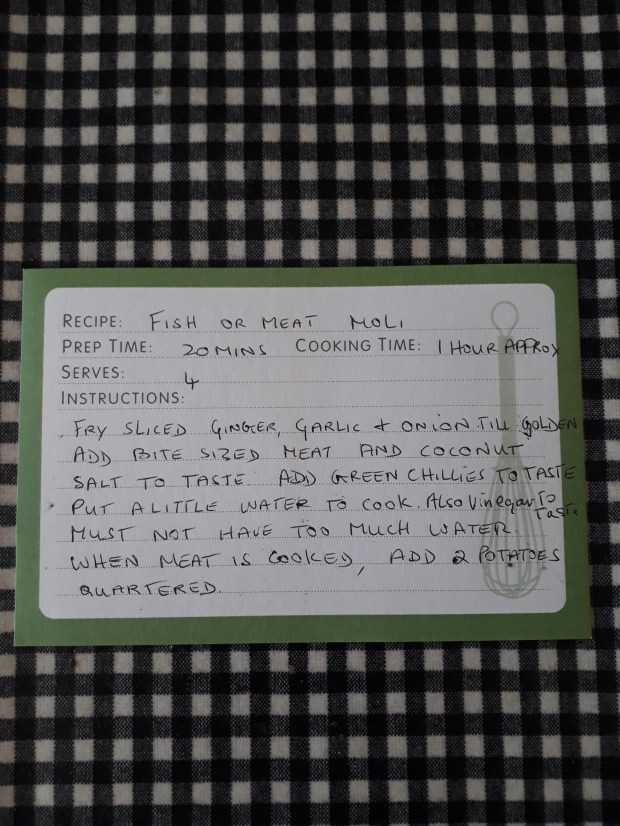
But for now, we remember Mum and her understated but delicious Fish Moli. I added cubed potatoes before I started writing this and they are now perfectly cooked so it’s time to eat. It’s not a complicated recipe – Mum’s simple instructions make that clear. Just don’t forget to add the vinegar.

20190616_152956-120190616_152945-1

(Some pictures of International Evening at Pip’s school, June 2019)


20190613_17173920190613_165251

(The Paneer Kathi Roll process)

20190613_11473120190613_11555820190613_122213

(And when you think only the best Samosas and Pakoras will do…)

20190613_111031

ND. Xx

Family Food

20180906_203602

Last weekend Kris turned 40. When he turned 30, we needed a minivan to get us from Southall to Central London and Mum and I got rather ‘merry’ on the way there drinking sips of vodka that was being passed round Jeff and Kris’ west-side mates. This time it was just me, Jeff and Kris and some close friends.

Whenever there’s a birthday or wedding, Mum would make kebabs. It’s been a while since I last made them but thought 40 would be a nice present for Kris. I’d forgotten how long they take! I was going to surprise the birthday boy with them but thought they might spoil, or get eaten, before he got to enjoy them so they are currently in the freezer until the remaining Southall Griffithses assemble later this month.

Remaining Griffithses. It’s been over two months since Dad died. He was never a party person unless it was at home or at a familiar local venue or with friends or family he’s known forever. Even though it was rare to see him at our birthday drinks, his absence was definitely felt. Kris gave a toast to him and there were some pictures on the wall of him in happier times.

I’ve not really fancied big meals or spice in recent months but weirdly I’ve taken to some old school comfort classics like cheese on toast or bowls of cereal for dinner. My favourite Dad meal was cheese on crumpets, cooked to perfection with slightly burnished edges and crunchiness. In the last year I introduced Dad to the delights of a scraping of marmite before adding the cheese and he, skeptical at first, thoroughly enjoyed it. He used to make cheese on toast for us when we were kids with a layer of Branston pickle or brown sauce. I can’t remember why he stopped making it.

Another Dad classic is perfectly soft boiled eggs. His trick was to bring the eggs to a boil and immediately take them off the heat and leave them for 3 minutes. Mum and I liked to smoosh the eggs up with ripped up toast in a bowl and gobble it up like infants. Dad would then quickly discard all the shells and start to wipe up all our mess, often before we were finished. He’d moan benevolently about the mess on the floor but we all knew he loved sweeping with his special brush and long-handled dustpan.

Probably my favourite memory of him serving me food is when Pip was two or three days old and I was glued to the sofa looking like a crash victim, Dad would appear with a tea towel over his arm, a small table in one hand and a quarter plate with chocolate biscuits cut up into bite sizes in the other. He didn’t say anything before coming back with a cup of strong tea and a coaster and then he would settle on his own sofa and we would watch hours of Judge Judy. He liked half a cup of black coffee with half a teaspoon of sugar about 10 times a day.

When Pip was older, from about 2 years old, she’d wake up early (about 7am!) and wander into the living room where Papa would be waiting with arms outstretched and breakfast served on the little coffee table in front of Cbeebies. Her little pink armchair was positioned at an angle so she could comfortably get behind the table. Breakfast was a fixed menu of a bowl of cereal, rice krispies, cornflakes or hoops, a glass filled with blueberries, raspberries and strawberries, a glass of milk or juice and three jellybeans. Sometimes smarties. I would wander in between 9 and 11am to find Mr Tumble blaring, Dad on his fifth cup of coffee, Mum on her computer and Pip redecorating the living room. When Lara came along, the two of them would launch themselves off the tops of the sofas onto a prepared springboard of cushions, bedding and teddies and Dad would sit tranquilly amid the chaos.

Over the past 8 years, visits to Stowmarket would always include a day trip to either the seaside or a quaint Suffolk village where we would have an extravagant lunch. Mersea Island for oysters, Felixstowe Regal for fish and chips or the Ferryboat Inn for trout, sea bass, seafood and pies. Bury St Edmunds for teashop jacket potatoes and cake, a range of gastropubs for steaks, fine wines and fancy puddings or the local Shepherd and Dog for German schnitzel and lately the Magpie for English pub grub and pints. On market days we’d get fresh bread, olives and pastries, cheeses and fudge. Mum loved savoury nibbles, Dad loved chocolate and sweets. When clearing out the house, I found jellybeans stuck to the inside of drawers and tupperware shoved to the back of cupboards still filled with hot gram and old crackers.

When Mum died, Dad courageously invested in a rice cooker and a halogen oven in order to keep the hot dinners rolling. He only used them once each. He did buy and use a big frying pan for the stir fries he got into and the freezer was stocked with dubious looking ready meals, choc ices and unopened bags of veg. Every day he’d tell me on the phone what he was having for dinner. Brussels sprouts and carrots always got a mention but judging from the size of his belly, I doubt many greens made it onto the menu. The carefully stacked Fray Bentos pies told a different story; blocks of cheese dwindled every day and slabs of chocolate wrapped with an elastic band was a feature of his snack drawer. When he died, I found receipts in his car of the daily trips to Tesco for milk, and impulse fruit pies or other sweetmeat in packages of two and, on his last trip, a tub of ice cream. He also loved a McDonald’s breakfast muffin and black coffee, receipts for which there were many. The last few months were definitely characterised by fast and delicious food and, judging from the ancient burnishings in the oven, not much was home cooked by himself. When I visited, I made old school Mum style lasagnes, shepherds pies and chops with mash and apple sauce. Dad loved his spuds with a sprinkle of salt in a sea of beef gravy which was mopped up with a slice of white bread.

When in Holland recently I was reminded of our holiday frites when we used to drive down to Italy. Dad used to stop once on the way down and once on the way back if we were lucky at a French frites wagon on the side of the road. We’d dunk the crisp salty chips in ketchup (never mayonnaise!) and sometimes we’d be allowed a fizzy drink – once Kris was relegated to the ‘punishment area’ at the back of our estate car for biting the glass and bloodying his lip. Ah the memories…

In Italy, market day in the town square in Garessio meant hot rotisserie chicken, salty olive oil fried French fries and cans or bottles of Chinotto. Dad would be in charge of holding the bag of food and you never saw chips disappear so quickly. Once a week we’d have a pizza. Dad always had ‘Quattro Stagioni’ with artichokes, mushrooms, prosciutto and olives, Mum had prosciutto e funghi and I would have something plain and not too cheesy. There was a sweet shop in town that made a range of local specialties including Garessini – a hazelnut chocolatey truffle piped squidge that tasted boozy and decadent. There were nutty biscuits with chocolate jam and viennese butter swirls with fruity gems. You’d ask for a pick and mix selection but the Garessinis always went first.

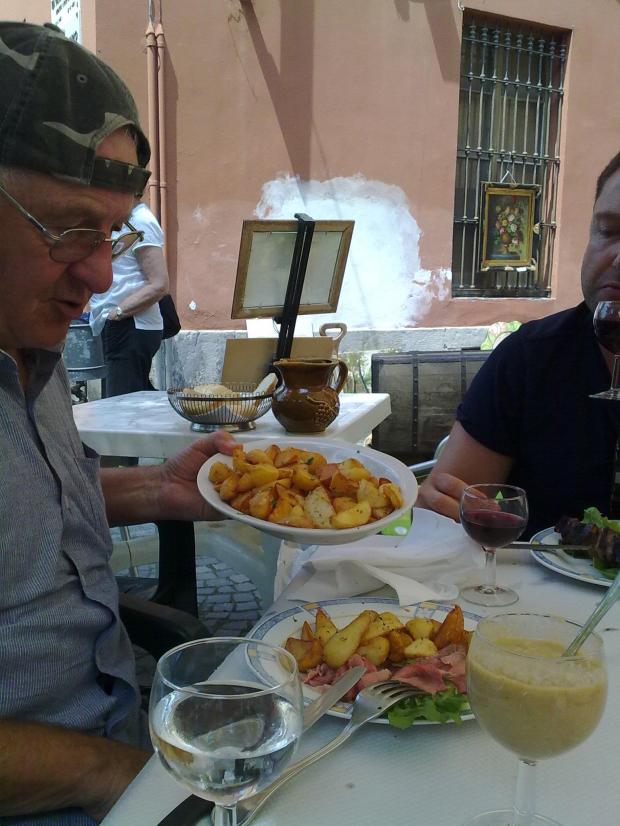
Going out for dinner in Italy was the best of times and sometimes the worst for us kids. Dad would be uptight that we would do something wrong but only we could see this – to anyone else he looked serene and jovial smoking his Benson and Hedges and drinking red wine or a cold bottle of beer. We’d eat lashings of tomatoey or pesto gnocchi, slivers of roasted meats in herby gravy, tiny roasted potatoes and green beans or calzones, spaghetti with langoustines and clams, stuffed peppers and aubergines or juicy Florentine steaks. On feast days there would be apple dumplings served hot from bubbling oil drums on the bridge and plastic compartmentalised plates loaded with unctious polenta mash and rabbit stew. Or you could have a platter of meats: local pork sausages with fennel and garlic, lamb arrosticini and different cuts of salami and cured meats.

Our longstanding friends in the campsite famously introduced themselves to Mum and Dad in the early 80s with a hollowed out watermelon filled with Sangria (or whatever it’s called in Italy) and they became firm friends. A group would assemble in the evenings around the barbecue where Dad would be cooking Mum’s tandoori chicken, skewered lamb kebabs and marinated beef steaks and she herself would draw a crowd when the curry smells would fill the campsite on rainy days. She was the only Mum I knew who would pack sunflower oil, Pataks curry pastes and tins of spices to go camping. The Italian nonnas on the other hand would make fresh pasta in their caravans and the table tops so recently strewn with lego would be replaced with pearls of gnocchi drying out before a quick boil in a salty pan. Dad brought along plastic disposable cups from his factory that made morning cups of tea and the ubiquitous Piemontese table wine taste even more delicious. He introduced us to breakfast beer (at that time not consumed in the morning) thanks to the French hypermarkets en route where we stocked up on those glorious cheap French stubbies, perfect for al fresco living.

In later years when Mum needed to dialyse three times a week on holiday, Dad, Pip and I would go sightseeing and find roadside eateries in the mountains and along the coast serving fixed daily menus of veal steaks, risottos, pasta with homemade ragus, seafood platters, antipasti with olives stuffed with meat, freshly baked focaccia and pickled vegetables and that sparkling red table wine you can only get in Piemonte. In their dotage, Mum and Dad liked staying in half-board villas where the evening meal would comprise various small courses of local cheeses, delicate soups, regional pasta such as trofie with genovese pesto, stews and meat, always too much for small appetites but never the same thing twice. Divine. Desserts would always be overkill but a strong espresso and mayhap some local grappa would finish things perfectly.

Mum and Dad gave us so many unforgettable culinary memories and yet the ones that stand out are the meals and experiences that were oft repeated – Mum’s biriani, Dad’s regular ‘snails and duck’ at Biggles and Paulo’s, cheese on crumpets, the Saturday morning fresh bread when bakeries still existed at our local shops, the Fray Bentos pies that Nana Griffiths would use to eke out a Sunday roast if we all descended unannounced and the glass of cointreu or amaretto at the end of a meal.

All of these memories flood back now that the summer is over and a new working year has begun. It’s the time when we normally start thinking about Christmas and booking holidays for next year. It’s sad to think that this year we are missing such lovers of food and family. I hope as we go on we will do them justice.
456297991835


Devil Fry

20180121_094024


20180121_120139

It’s just under an hour until a year exactly has passed since Mum died. It doesn’t feel like yesterday – it’s been a quick year in some ways but the events of the last 12 months have filled in a lot of the empty spaces.

Dad has pretty much redecorated the whole house, learnt to use Facebook and rid himself of prostate cancer; Jeff and Monika have watched our bundle of joy Lara learn to walk, negotiate far and near-flung staircases and swimming pools and start to call Pip “Peach”; Kris has rehabilitated himself after a year of Police service; Pip still hasn’t learnt to swim or ride a bike and Mark and I enjoyed having housemates until the autumn, which kept the wolf from the door.

Xmas came and went with pleasant company and plenty of lazy hometime. Thoughts of Nana were cheerfully recalled and her absence this year reminded us how the same time last year was much harder work.

I can’t forget what a shock it was to see her last Xmas day. She always made an effort for the family and ate a little but we all knew it would be a miracle if she survived another year.

I remember those few weeks of the new year much more fondly; she was blissfully narcotised on Oxycodone in her hospital chair and, even though mobility was difficult, she could still reminisce and chat and laugh.

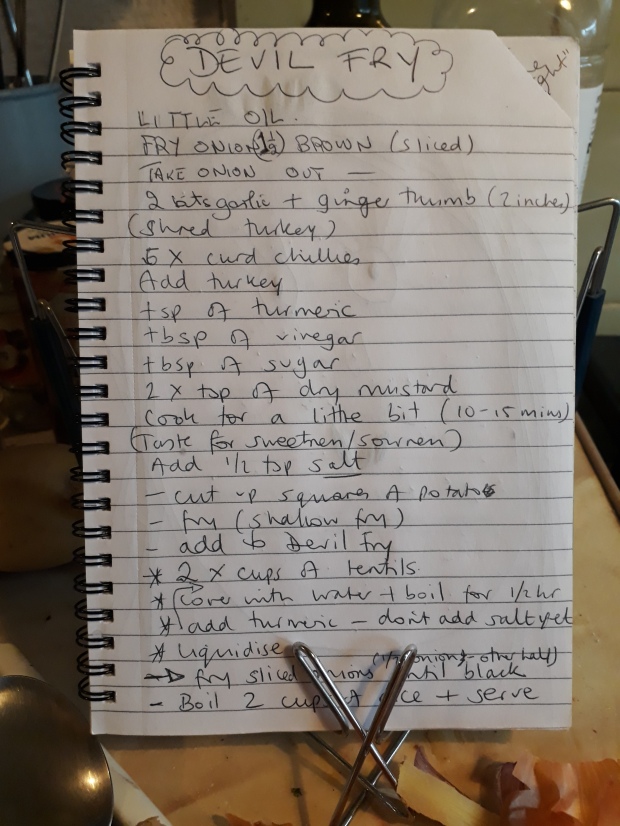
In fact the recipe for Devil Fry was written down around the time she’d tell me her wishes for her funeral. It wasn’t a devastating time – it was a time of gathering stories, memories and recipes. And how we laughed.

So today Jeff, Monika and Lara came for lunch and I fed them the Boxing Day favourite (although not mine) Turkey Devil as we called it. Not sure if I did it justice but the house was certainly filled with that unmistakeable scent of fried onions and ginger, which hit you every time you arrived at Woodstock Avenue or Poplar Hill or Astley Avenue for that matter…

It’s simple really but the balance of ginger, sweetness and sour vinegar takes a little practice so Mum’s teaspoon and tablespoon measurements are approximate for a turkey crown sized amount of meat. As she would say, “you need to judge it.”

I’m writing this on the sofa surrounded by the detritus of Lara and Pip’s toybox carnage. I’m not planning on doing much else for a bit except lounge and ponder the events of this time last year (20 minutes to go).

Mark has lit a candle. I’m grateful to him for keeping Pip at school last January in the week running up to this day. I’m grateful that I had that time by Mum’s bedside and the privileged position of being there when she eventually died.

Soon she’d be trying to wriggle off the bed and say her last words “it’s so hard to explain” before being comfortably tucked back into bed. Soon she’d give that last distant look across the bed. Soon her breathing would shallow but her pulse would stay strong for an impressive time until finally ebbing away. Soon she would be at peace.

It’s 14:42 and in 10 minutes time, a year ago, we lost the most fun-loving, thrill-seeking, super-cooking Mum, Nana, Wife, Sister, Niece, Cousin and friend we could ask for. Rest in peace Phyllis Griffiths.

FB_IMG_1492463840917

Karti Kebabs

It’s been six months since Mum died. This post is less about Karti Kebabs than it is about the weeks leading up to her death…

We all thought her time was up this time last year, in July 2016. There were late night hospital dashes, phone calls to family and friends and difficult questions for consultants. Adrian got the vibe from hospital staff that her heart was not strong enough to survive the mystery infection she was suffering from. The consultants confirmed her heart was very weak and advised against resuscitating as ‘bouncing up and down’ on her chest wouldn’t be much fun for her. He couldn’t give us any definitive answers. We gathered. We had the conversation. She knew it was bad.

Then all of a sudden she got her appetite back. After about 8 weeks of hospital food (which she rather liked by the way) she had a hankering for chow mein, dosas and rice. The hospital said it was fine to bring in food so for a couple of weeks Dad brought in takeaways. She thrived!

She couldn’t come with us to Poland to visit her new granddaughter Baby Lara but she was out of the danger zone so we felt like we could go. Mum made the trip a month before when Lara was born, even though she was at her frailest. It was the beginning of her decline.

Christmas 2016 came and went too quickly. Mum was glad to have the family together but she was visibly altered. She’d shrunk quite considerably and her head seemed too heavy for her frame. She sat looking quite comfortable however, sitting propped up on her chair while we made a fuss over Lara and Pip. Christmas was for them really. Paul had come especially to spend time with Mum and it was the first time in a long time that we were all together. It won’t go down in history as the best Griffiths Christmas ever but it served its purpose.

By the first weekend of January she could barely sit without excruciating pain. Her chest plate had been pushed forward by her crumbling spine. After years of dialysis, her bones were losing their strength. She went into hospital to be made more comfortable, which meant enough morphine to impress an athlete. Dad used the time creatively and had new doors put in.

It was my birthday on Friday 13th of January and normally they phone to ‘wish’ me but no call came. Bloody cheek… We visited that weekend and the sight of her was a proper shock. She was still her normal self, felt okay thanks to the Fentanyl (before it was famous), and was even having a few cheeky vapes. Apparently it was comforting. But she could barely lift her head. Her chest was distended and served as a useful shelf for her drooping head when she got tired. On the Sunday she dropped the bombshell that she didn’t want to carry on dialysing as sitting tied to a machine all day was too painful. She didn’t want to be in pain any more. As though we were discussing whether to go on holiday or not, I left her that evening agreeing that she wouldn’t make any decisions until the following weekend when we could all be together.

At school the next day, Dad phoned to say that she hadn’t gone to dialysis. That meant only one thing. The beginning of the end.

I got to the hospital that night and she looked pretty comfortable, as before. The only difference was the previously optimistic consultant now referring to her treatment as ‘palliative’ care. The only treatment that recognises the end of life as the objective.

I was surprised she was not in her own room, but with hindsight, this made it more normal. There was talk of hospices but there was also talk of bed shortages. I don’t think any of us cared. She welcomed visitors, chatted nonchalantly and even said things like, ‘this is fun! Maybe I’ll change my mind.’ How we laughed.


45

The week passed quietly. Friends and family paid their respects. It sounds conceited but I enjoyed a pleasant feeling of role reversal – here was my mother in a hospital bed, cuched up like a swaddled baby and here was I, sitting nearby, watching her breathing while she slept. It’s the same anxiety you have with a newborn and it’s the same feeling of relief when you see the chest rise and fall eventually. She would rouse herself like a baby too. Eyes open blearily, furtive glances at the strangers sitting round – a quick identity check then back to sleep contentedly. During more wakeful hours she would shift uneasily until finding a new comfortable position. She would say she felt okay. She wondered when it would start to feel strange. You could work out when a new dose of Oxycodone was needed rather like baby’s next feed. As babies thrive with each new day, Mum became sleepier. Her train of thought was disorganised and she’d make funny slips in conversation, which she could hear and would amuse us, herself included. Her sense of humour never failed her.

On Saturday 21st January, I remember how beautiful the sunrise was. There is a playing field beyond the carpark outside her window and I would walk around it while she had her morning wash and change. It was a quiet day. We were expecting Aunty Smita and cousins Shirley and Anthony in the afternoon. She enjoyed sitting in her comfy chair during the morning and would receive her visitors looking her best. There was something lazy and summery about the ward. Even the bustle of the lunch hour was subdued. She always ate her lunch, even if though she had no appetite and could barely lift her head. This time it was cod in parsley butter and mashed potatoes followed by rice pudding. We shared it companionably – even the smallest portion was a bit too much. Lucky me!

After lunch, the ward dozed and the nurses drifted. At 2.40pm Mum decided she needed the loo and was trying to wriggle herself off the bed. We laughed about how pathetic she was (that’s the kind of bants that happens in hospitals). When I asked how she was feeling she said, ‘it’s so hard to explain…’. The nurse and a ‘healthcare assistant’ (who does everything the nurse does but wears different clothes) helped ease her off the bed. Even though I normally leave them to it, I stayed, partly in order to hold her head up and partly to help her back into bed (we had a system based on pivoting and sliding). All was well until the moment her head was back on the pillow. I saw a look pass her face. It was a look you see in the movies and it was the moment in the film when the assembled folks give each other another meaningful look. The healthcare assistant stood beside me with an arm around my waist as I put my head next to Mum’s. Her breathing shallowed and stopped. The pulse in her neck was strong. We watched it ebb. We marvelled at how strong it was. It became fainter and fainter and finally faded away.
I’m not sure how long we stood like that but eventually the staff left me alone and I made the calls. I put things in a bag. Aunty Smita, Shirley and Anthony arrived and paid their respects. Before long, it was time for me to go. The sunset as I walked across the playing field was remarkable. The hymn “I Watch the Sunset” came to mind and I was overcome with a confusing sense of birth and mortality.

Sunset

I remember thinking how peaceful the end was and so unexpectedly clean and quiet. The opposite of labour yet somehow the same. I had the strangest feeling that she was present at my birth and I was present at hers. I remembered her saying that when her dad, Papa, died, she was holding his head and heard the breath leaving his body in one long exhalation like a whisper.

For a long time I have woken in the night and looked around to check if Mum’s still breathing. It’s not a pleasant feeling but at the same time it’s a reminder that she is at peace and that is comforting.

For the funeral reception I wanted to make Mum’s famous kebabs but was confounded by the fact that no recipe existed. Luckily I had time to grill her for recipes (apologies for unfortunate image there) and this is what she said: ‘You’ve watched me. Just judge it nicely.’

Mum funeral order of service

Karti Kebabs

Makes 20 (I actually could only get between 16-18 kebabs from one block of pastry at first but got more with practice)

For the meat (combine ingredients thoroughly and marinate overnight):

500g diced pork (I prefer pork strips that you can dice into really small pieces – the size of dice in fact)

2 tablespoonsish Pataks Madras Kebab Paste

1 tablespoonish natural yoghurt (too much and your cooked meat will be too watery)

For the rotis:

1 block of bought puff pastry

Flour for dredging/rolling pastry super thin

For the filling (chop finely):

1 large brown onion

2-4 green chillies depending on how hot you like it

lemon juice

Method

This process will benefit from a cook with military/factory line experience. Use a rolling pin you are comfortable with. Mum preferred a narrow stick, I love a fat drum with handles:

  1. Cook the marinated meat at 200 degrees C for about 30/45 minutes until burnished but not too dry. Stir the meat a few times during the cooking process. Allow to cool but not completely before you use a spoonful at a time to fill your rotis.
  2. Roll your rotis thin enough that they won’t split yet robust enough to not crisp up in the pan. You also need to be prepared to roll and watch the frying pan at the same time, which is quite stressful! Have a few rolled before you start, but not so many that they dry out. Carefully place one roti at a time into a dry frying pan over a medium heat and then get rolling the next ones as each cooks. There’s enough fat in the pastry. You have to judge the heat as you would making pancakes: too hot and they brown/crisp too quickly, too cool and they crisp due to the length of time exposed to the heat. Remember that the area of the roti will reduce with the heat so try to be fleet handed. Use the rolling pin to transfer the roti from the table to the pan. Don’t let the cooked rotis cool so much that they become unwieldy nor be too hot so the meat/juice seeps into the roti. You can stack the cooked rotis while you crack on with filling them one at a time.
  3. Have your chopped mixture of onions and chilli in a bowl ready and your bottle of lemon juice (I’ve never tried using real lemons!) next to that. Place a cooled (but not too cool!) roti on a plate; spoon your cooled (but not too cool!) meat in a line across the top; spoon some onions/chilli on top of the meat and douse the line with lemon juice (the more the merrier). Roll into a tight double open-ended wrap and place on a clean plate (or onto a large sheet of tin foil if you are freezing them). Repeat until all rotis are filled. At this point they should be cool enough to freeze (and freeze they will beautifully – all you need to do to defrost them is put them into the fridge for a few hours) or consume immediately, whatever. I prefer putting them straight in the fridge and letting the flavours combine. The chilli loses some heat and the tanginess gets through to the meat. We always eat ours cold!

karti kebabs


Stew

20160716_202338

We called it stew although it never took very long from the first idea of making it to the unmistakeable clovey, vinegary, meaty, spicy yet herby fragrance filling the house to that sated feeling of wellbeing after your second or third helping. In other words, very little stewing takes place.

My memory is that this Anglo staple was a weekly meal when I was growing up, but it was probably only once a month due to Mum’s school-night dinner repertoire of stuffed hearts, faggots, lasagne, Oriental beef, dhal and rice, spag bol, sausages –  the usual Anglo-Indian-Welsh suspects. This dish though was not my favourite when very young; there must have been a turning point that led to complete slavering commitment to its warming deliciousness. Perhaps it was that well-known adolescent rite of passage when cauliflower and broccoli are no longer vom inducing. Perhaps only then are we truly adult.

Mum’s stew is not really a proper cowboy/cassoulet affair as she never cooked it for very long. Just until the meat was tender enough to allow time for the potatoes or suet dumplings (or sometimes both) to cook or flump up.

And Mum’s approach to tender meat was to cut diced beef into tinier cubes to reduce the cooking time, increase the meat-on-spoon ratio and, classic Mum, to be thrifty with her resources. Ever the economist, Mum wouldn’t bother with expensive cuts of meat (and would often criticise me for buying fancier stuff) and for a dish like this, I can understand her reasoning. The meat isn’t necessarily the star of this show (although this didn’t stop us diving for pearls of meatiness when it was our turn to help ourselves) because of the tangy red unction, softened cauliflower and floury, tender spuds.

I tried making this as a student, reluctant to always be phoning Mum for help, and always getting it wrong because I’d missed some seemingly irrelevant yet undoubtedly indispensable bay leaf or nub of ginger.  Invariably I’d add more vinegar than was necessary (being a good half-Anglo) and I’d end up with flavourless thin, cauliflower and tomato soup with tough, but expensively julienned, fillets of Duchy, free range, organic, sustainable cow from the a farmer called Jasper or similar…

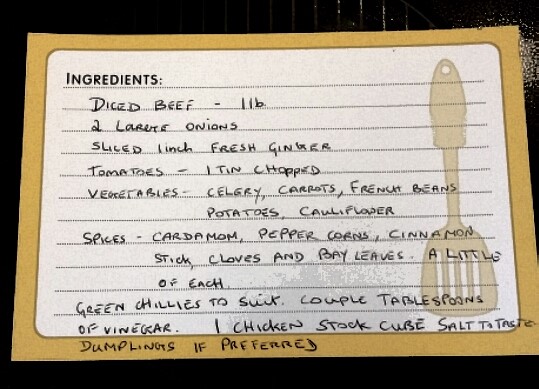
Mum’s recipe calls for modestly essential Anglo ingredients: ginger, vinegar, cloves, cardamom, chilli, cinnamon and peppercorns and a daitchkey brimming with onions, celery, carrots, beans, tomatoes, cauliflower and potatoes. You know you’re a little bit Welsh when you require stodgy dumplings as well as the spuds to fulfil a paternally inherited need to mop juices with sliced white bread. You know you’re Anglo when you’ve made the above but don’t feel satiated without a portion of fragrant basmati rice.

I made this for my brother and Dad a few days after Mum died in that period when close family sit around and either pretend to feel alright or have little bursts of tears when they realise they haven’t asked all the questions they should have like “how much is too much cornflour to thicken?” It was a success, even though I hadn’t found the recipe cards yet.

I recently made it at home, again without the cards and it was bloody awful. I’d forgotten stock cubes despite using posh fresh beef stock and I replaced chilies with West Indian hot pepper sauce that masked all the other flavours. It was bland and chilli hot.

I asked Dad to bring the recipe cards with him on today’s visit to Aunty Rita’s in Worthing and, not understanding what I meant, filled the boot with half her recipe books and not the little linen pouch that I’ve kept safely in her kitchen. So, once again, I’ll have to post the actual recipe next time I go to Suffolk.

We are staying in a Travelodge family room overlooking the sea. We came a few days after Mum died to see Aunty Linda before she died and then again a few days after Mum’s funeral. It’s funny how I associate Worthing with Mum even though I don’t think we’ve ever been here together more than once or twice.

I still catch myself forgetting she’s dead. Yesterday, my cousin Catherine, who lives across the road from Mum and Dad, posted a picture of rice and peas and, for a split second, I thought ‘I wonder if Mum made her that and sent it over’. Then came the familiar sinking feeling…

Last week Pip and I went camping and I regaled our friends with memories of karti kebabs, tandoori chicken and paraffin stove beef curries. Mum’s curry powders went camping with her so I feel ashamed that we just took biscuits and sandwiches this time. Pip’s not entirely ready for Mum’s stew but luckily she understands that I’m trying to make Nana’s recipes partly for her benefit. It will be quite a feat to pull off the Phyllis Griffiths approach to camping so in the meantime I’ll stick to these old favourites.

Try it! But don’t forget to add tiny morsels of inexpensive beef and lashings of vinegar.

Beef Stew Recipe

Beef stew method (2)Beef stew ingredients (2)


Biriani and Hell’s Flame

39

Probably my favourite Mum recipe, this dish is actually very easy to make if you have a jar of Patak’s Biriani Paste. However, the simplicity can be deceptive if you are a rice-cooking amateur. I’m no professional and I often mess this up – too much rice means the stodge factor is increased. Burnt bottom (some of us like it that way) is fine as long as the burning flavour doesn’t pervade the whole pan. If you are cooking for more than four adults, you’re gonna need a bigger boat.

Mum used two types of daitchkey (sp?) – a huge metal one for lots of people or a heatproof lidded casserole for when she made it in the oven with yogurt and spices and things (she didn’t leave me that recipe…). She always said that the best biranis were Pakistani ones. I’ve had a fair few birianis in my time and I know what she means: layers of multicoloured tangyness with beautifully tender beef served with lashings of fried onions and maybe some cashews? I’m sure some birianis have nuts in them.

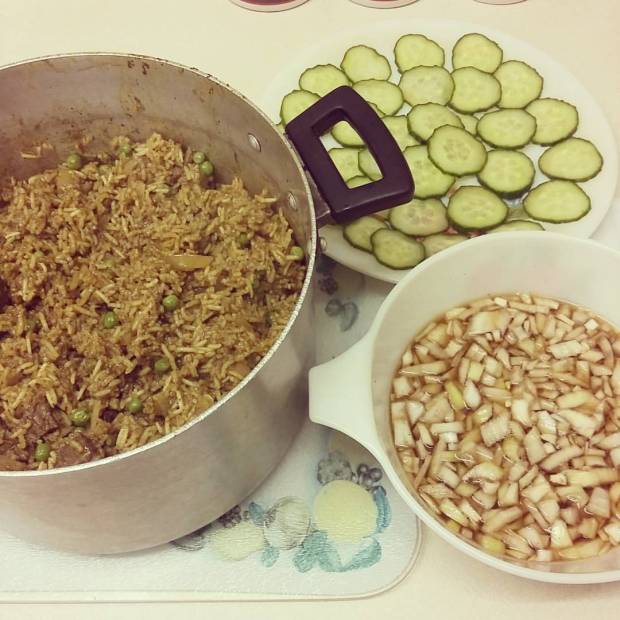
Anyway, Mum’s standard biriani (or ‘biz’ as my Welsh Dad calls it – I’ve only got one dad, what am I saying?) is beef or chicken, fried with the biriani paste and other spices, basmati rice and peas added later. Because us kids are half-Celts, Mum sometimes added potatoes (I know, carb overload). The most important element of the dish, however, is the drenching of Hell’s Flame that takes place once you have loaded your bowl (and bowl I always use, never plate).

Hell’s flame really is the devil’s work – raw onion, chilli powder, sugar (a bit of devillish jiggerypokery) and malt vinegar. It’s the tangyness that turns it Anglo-Indian. Not putting hell’s flame on your biriani is like not having salt and vinegar on your fish n chips. Or ketchup if you really like ketchup. The raw onions give enough crunch to balance the ricey texture and the tang of the vinegar followed by sweet and sour heat completes every mouthful.

Every one of Mum’s curries is accompanied by a plate (often the 70’s rose detail one) of sliced cucumber, tomatoes and spring onions sprinkled with salt and drizzled with more malt vinegar.

This is the dish I would request most often when visiting Mum and Dad. You could depend on it even if I hadn’t been asked what I fancy before I arrived. Invariably, Pip and I drove from London late in the evening, often on a Wednesday night in the early days when Pip didn’t go to full-time school (four day weekends – whup!) and there would be a daitchkey with enough leftover for several portions, even if it was late at night! Better yet, I would have my fill but make sure I left some for breakfast biriani… Perfection.

Most restaurants outside Southall serve biriani with an accompanying vegetable curry. I don’t see the point. I judge birianis on whether they can survive without any accompaniments (other than vinegar!). I think of biriani like an Italian risotto. Perfect just the way they are.

There’s a south Indian takeaway chain called Sambal Express which serves a really spicy version of mutton birani that tastes very similar to Mum’s. They have a store in Southall. They also do a delicious range of street food and snacks. My favourites are fish and egg rolls and fish rotis.


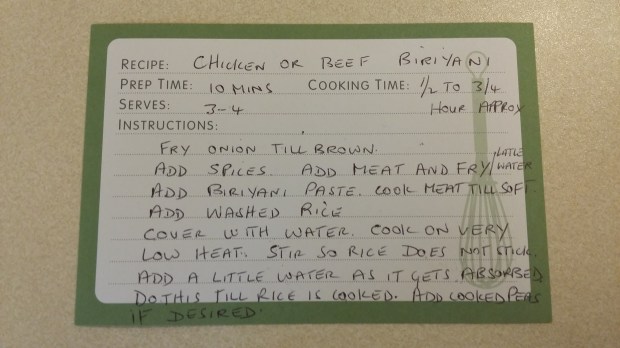
Mum’s Chicken or Beef Biriani Recipe

Biriani methodBiriani ingred

Hell’s Flame Recipe

Combine the following ingredients in a serving bowl:

1 brown onion – diced

Half teaspoon (or more!) of chilli powder

1-2 teaspoons granulated sugar

Enough glugs of malt vinegar to almost cover the diced onions in your bowl