This weekend is the 2nd anniversary of my Dad’s departure from this world. My Uncle phoned earlier to commiserate and, yet, we spoke less of Tony Griffiths, and more of our present lockdown stories: not going to Oz and getting a new dog (Uncle Mal) and having scaffolding erected and watching the new Will Ferrell film ‘The Eurovision Song Contest: The Story of Fire Saga’ (me). In fact, we didn’t talk about Dad at all. We didn’t even talk about bread, which is second on my list of things to think about this weekend.
I’m currently in the throes of bulk rising a couple of loaves to give as presents. There’s an elemental joy to making sourdough bread from scratch (even if it isn’t as ‘nice as white bread’ as my fave writer Nina Stibbe famously tweeted recently). I think the joy comes partly from the powerful alchemy of flour and water creating a life of its own and partly the deeply sublime feelings of hope and fear that balance poetically somewhere deep in the soul/stomach. Is this what Keats meant by negative capability?
I have lockdown to thank for this. Thanks to Covid-19, I finally learnt how to make a sourdough starter (one of the many ‘Lockdown Cliches’ of which I am guilty). After the initially laborious task of making it, you have, potentially, a life-time’s supply of sustenance, provided you have flour and water and salt in abundance thereafter. And an admirable range of Le Creuset cast-iron Dutch ovens, a heat source, a sharp edge, myriad tea-towels, a cotton bag, and posh butter and/or marmalade. What more does one need?

I don’t think my Dad would have been much fussed about my sourdough efforts. I recall with great fondness his penchant for soaking white sliced bread (or plastic bread as Nigella calls it) in his gravy like a good Cockney Taff. His favourite type of bread.
But he did have a classier palate when we were out and about. We would drive an hour into Essex from Stowmarket to Mersea Island for its fish platters and oysters when Mum was alive, with a pitstop at Morrisons for the BYOB (Bring Your Own Bread) and aioli. I always, always got a sourdough loaf and only got ciabatta if they were out. At The Company Shed it was encouraged that you brought your own stuff to mop up the fishy bounty. You were not allowed to book a table so, if it was full, we’d go to the less permissive, but equally delicious, West Mersea Oyster Bar, where we would order our platters and sit outside to enjoy the fresh langoustines, prawns, crab, and two dozen oysters with hunks torn from the communal sourdough loaf, dunked first in the garlic mayo, all swashed down with cold beer, 7Up, or Prosecco.
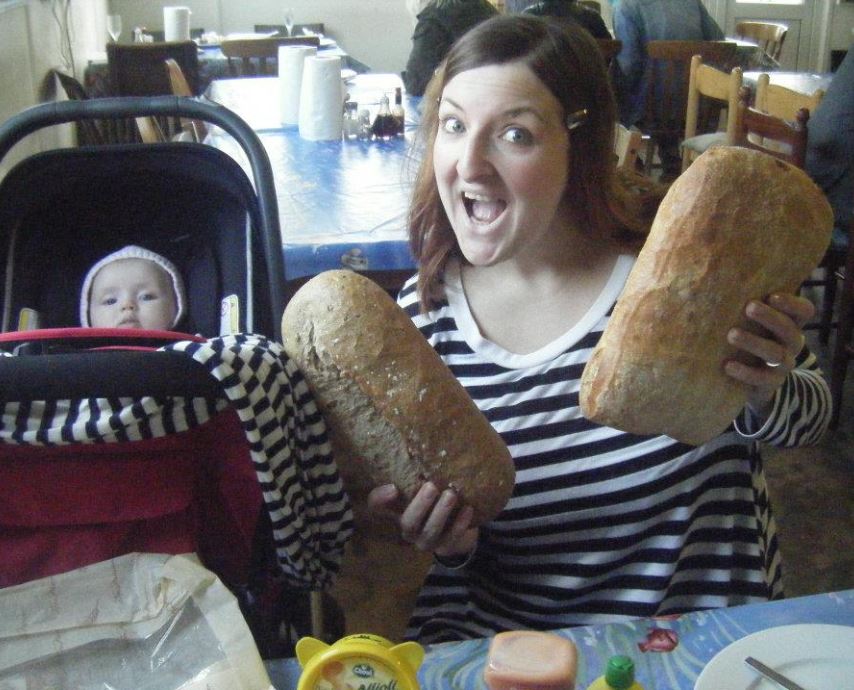


Those were the days. Dad and I went back only once after my Mum died as a sort of pilgrimage. We didn’t bother with the sourdough but we did have plenny of fish and sad gulps of fizz.
Mum hardly ever used to bake her own bread. She had a foray into the world of bread-machine baking for a bit and absolutely loved trying to recreate the focaccia we used to eat in Italy all the time. But sourdough was best bought or used as bowls for that incredible San Francisco bay chowder we all had to try on our separate American adventures.
What is it about sourdough and fish? All I know is that when I use the sourdough discard (get me with all the words) in Pip’s weekend waffles, she complains that it tastes fishy! Sourdough bread though definitely does not taste like fish. I don’t even know why I’m thinking of fish. I suppose the sharing of those Mersea Island meals was what made it special and they say that sharing bread is a pretty good thing to do. So, for the first time, I’m making some loaves to share with friends. It’s worrying because I never know how the bread will turn out until I’ve sliced it (or better yet, torn into it). I also thought it would be nice to present some of my three month old starter along with the bread so that if it fails, they can have a go themselves.
I bought a 25kg bag of rye flour when lockdown started so my starter is 100% rye. I followed Anja Dunk’s sourdough starter instructions from Strudel, Noodles & Dumplings cookbook and then watched a number of YouTube tutorials about baking sourdough bread. My favourite is 15 Mistakes Most Beginner Sourdough Bakers Make by Mike Greenfield/Lifebymikeg on Instagram.
Here is my version of the combined tips:
Nikki’s Lockdown Rye Sourdough Bread
Makes 2 loaves
Ingredients
150g of activated rye starter (see method for instructions)
1000g of flour (see method for flour types)
700-800mls lukewarm water
10-20g salt (French rules say max 10% salt but I’m not French!)
Optional – handful of sesame seeds of linseed
Method
- Activate your starter. To begin the process you need a starter. My starter was made from adding equal amounts of rye flour and water to a bowl each day for about 6 days until it became active – bubbly and frothy. I then kept a jam-jar full of this starter in the fridge, which is easily activated in a few hours. This recipe begins with a jam-jar full of rye starter in your fridge (or presented to you by a friend).
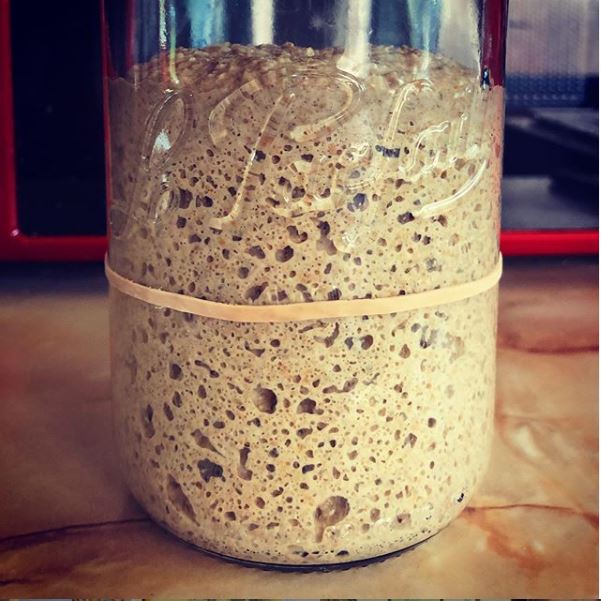
Remove your sleepy starter from the fridge and scoop the contents into a bowl. Add 100g of rye flour and 100mls of lukewarm water. Combine until you have a firm, wet paste. Scoop/smear this new mixture into a clean Mason jar or bowl (it needs to hold approx 500g of flour). If using a jar, put an elastic band around its waist at the height of the mixture before it starts to rise. This will show you clearly how far up the jar your mixture has risen. Leave the mixture in a warm place (around 21 degrees at least) until it looks bubbly and has approximately doubled in quantity. This activation takes about 2 hours in a warm room.
2. Autolyse the flours. Measure out 1000g of your chosen flour. My quantities are as follows based on the best bread I made at the start of lockdown:
- 600g white flour or spelt flour
- 300g wholewheat flour
- 100g rye flour
Mix all the flour with about 700mls of lukewarm water or until you feel there are no dry bits left in the bowl (professionals call this hydration level and use percentages eg 700mls water = 70% hydration. I tend to use somewhere between 700-800mls water). Don’t worry if the mixture looks wetter than normal bread dough – the flour will absorb lots of water throughout this process. Cover the mixture with a plate/clingfilm and leave aside for 45 minutes.
3. Make the bread dough. When your starter looks active (nice and bubbly and doubled in size), measure out 150g and save the rest in an old jam-jar for next time*. Combine 150g of activated starter with 15g of salt to your autolysed flour mixture. Mix well. You can use your hands at this point if the mixture seems too tough. Always use wet hands. Cover and let the dough relax for 30 minutes.
(*You can put your jar of starter in the fridge if you’re not going to use it within a week, otherwise it can just stay out on your tabletop. It’s best to keep it in the fridge if you are not planning to use it again within a couple of weeks and it can stay untouched up to about a month. After a couple of weeks in its inactive state in the fridge, it might separate: just stir the liquid back in. If mould develops, chuck the starter and start(er) again. But do try to keep it alive – remember, it’s easy to keep it healthy by adding any equal quantity of rye flour and water. Keeping it alive during lockdown was easy as every few days I tried a different sourdough recipe. Some recipes only call for a spoonful so you don’t need to do the 100g rye/100 ml water activation, just add a spoonful of each and wait a couple of hours.)
4. The no-knead ‘Stretch and Fold’ method: instead of kneading the dough for 10 minutes like many bread recipes demand, sourdough benefits from the old ‘stretch and fold’ method, widely demonstrated on YouTube, but is essentially using wet hands to scoop out sections of the dough, stretching it up and folding it into the centre of the dough, turning the bowl about 30 degrees and then repeating about 10 times until you’ve turned the bowl 360 degrees, stretching and folding as you go. It takes about 30 seconds to stretch and fold.
People freak out about it because you now have to repeat the stretch and fold method every 30 minutes for two hours, ie, 4 times in total. This may seem outrageously long but if you watch 4 episodes of Friends in the meantime or a 2 hour feature film that you can pause, it’s no big deal.
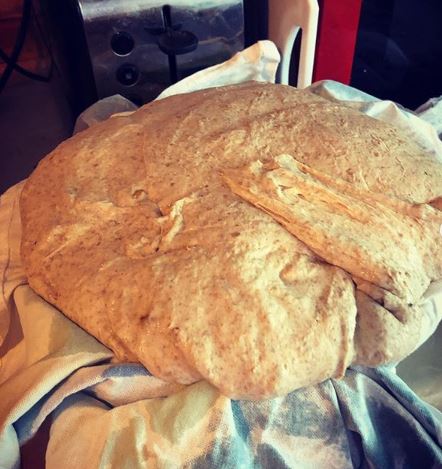
5. The Bulk Rise: you will have noticed that the texture of your dough is more elastic now that it’s been lovingly stretched and folded. The flour is sucking up the moisture and the gluten is working. It’s now time to put the dough to bed for a few hours – anywhere between 3-6 hours – ideally in a room that’s at least 21 degrees. You can also put the dough in the fridge at this point and leave it overnight (approximately 8-10 hours); the dough will still rise but at a slower pace. *The following picture is what happens if you leave it for too long even in the fridge!*
After the bulk rise, your dough will have risen (I hate reading this next statement…) until it has approximately doubled in size. (What does this even mean?! You will see that it’s risen at least a bit and, for your first time, you just have to trust that it has done something good after all the hours it’s been left to ferment.) The dough will need another period of rising next. But, before this, you will need to shape it into the loaf that it will finally become. The shaping instructions come after the next important stage which is preparing your bannetons or bread shaping bowls:
6. Prepare your bread basket: I bought a ‘banneton’ for my first sourdough bread and it’s really brillant for ensuring your loaf keeps its shape. It’s a cheap looking, wicker, spiral-coiled bowl that you dust with rice flour. It will support your dough ball (or boule) in its second rise. So, get these out (you’ll need two if you’re planning to bake the loaves at the same time) and dust them with rice flour ready to receive the dough.
7. Shaping: flour your surface (and yourself and the floor just to be on the safe side) and tip the large bowl of dough onto the table. Using a dough scraper (I made myself a dough scraper out of a 4pt plastic milk bottle and it’s way better than the one I bought later when the lockdown craziness settled a bit), cut the dough in half so you have two equal sized dough slabs. Collect one up and put it back in the bowl and cover it with the plate/clingfilm again. Leave the other dough slab on the table to rest for 10 minutes.
This next bit’s fun and I won’t blame you for looking up visuals for it. Top tip: try not to use too much flour as it will dry your dough and prevent it sticking to itself. (Top tip 2: pour out a sprinkle of linseed or sesame seeds on another bit of table surface if you want your loaves to have a more interesting crust.)
Flatten your doughy slab that has, by now, spread out a bit on your dusty table. Shape it into a rough square with your fingers, then take its four ‘corners’ and pull them into the centre of the dough, sticking it into itself, creating a sort of dumpling shape. With floured hands, turn the ‘doughmpling’ over and then cup it, using the bottom edges of your hands to turn the ball on its axis 360 degrees, building surface tension as you go. You will get better at this. If the dough is unwieldy and too floppy, just step away from it, dust your hands again and step back into the breach. (At this point, once you have the best sort of dough ball you can muster, grasp it in two hands and dunk the top into the sprinkling of linseed/sesame seeds if that’s the way you want to go).
Once you are happy with the dough ball surface tension, place it into the banneton seam side up (ie, drop the ball upside down into the basket because you will later tip the whole thing out again onto your baking sheet – the top now will eventually be the bottom of your loaf).
I like to cover the banneton with a clean tea-towel (one of which depicts the Shipping Forecast), then put the whole thing in a plastic bag before putting the lot in the fridge overnight. (I think sourdough likes creating gas but not getting dripped on, much like ourselves.)
Repeat the shaping for the second dough ball.
Now the two dough balls needs another rise. I always time this for an overnight sleep so they can go in the oven in the morning. If you did your bulk rise overnight, you need to complete the second rise either in the fridge for another 8 hours (in which case you will be baking in the evening of the same day) or at room temperature for approximately 3-6 hours so you’ll be baking in the afternoon.
This second rise doesn’t have to double in size, just a bit more than when it went into the banneton. The dough should eventually have a spring to it that slowly bounces back when you prod it. I hate to say this here but if the dough gets too springy, it may be over-proved, in which case you’ll want to bake it sooner rather than later. This will come with practice so don’t cry if it happens first time round.)
Again, trust the fact that after about two hours of room temperature rising after shaping, the active bread will be doing stuff so you’ll end up with something edible.
8. Heat your oven: get your oven and baking sheet(s) or Dutch oven(s) as hot as possible. Crank the oven up to 250 degrees an hour before you want to bake. For my first loaf, I used my 20cm blue cast iron casserole. I put it in the oven when the oven was cold, otherwise the enamel could crack.
9. Scoring: Obviously you are getting 12 points for effort (Eurovision scale) but that’s not what I mean: you need to slash your dough with a razor (lamé) or super sharp knife so it rises prettily and effectively in the oven. Here’s what I do:
Take your first banneton out of its plastic bag and remove the tea-towel. You can either tip the dough onto a sheet of parchment paper, or straight onto your hot baking sheet or into your smouldering Dutch oven. I went parchment first because I was scared of the heat, but now I just dump and score. Try to dust off excess flour once you’ve bravely tipped and dumped.
Cut deep slashes into the dough – I go for the simple cross because I like the uniformity, not the patriotism. Try to do this quickly so the dough doesn’t spread too much (too much spread means you will end up with a flatish loaf). You want to get the dough in the oven as quickly as possible and as snugly to benefit from what we call in the biz, ‘oven spring’.
10. Bake: finally the time has come! Put the lid on your Dutch oven and slam it into your English oven or, if you are using a baking sheet, slide it in, but you will need to put a casserole dish in the bottom of the oven and pour in boiling water before you slam the door shut to create a steamy love oven for your buns bread. Leave the dough to bake for at least 20 minutes but try to leave it without peaking for approximately 30 minutes. You may take a peak after 20 if you have a particularly scorchio oven like mine. Turn the oven down to about 210 and either remove the Dutch oven lid (I take the whole loaf out and put it directly on the oven shelf) and bake for a further 5-10 minutes so the outside crisps up evenly. Finally, using asbestos oven glubs, remove the bread (and bread it finally is), hold it upside down and give it some sharp raps with your crooked finger knuckle. I used to loathe this following statement but now I totally get it – the bread is done when it sounds hollow. This is about 35-40 minutes after you put it into the oven.
If you have read this far, you won’t mind me sharing the following grain of wisdom: you cannot overbake homemade bread even if it’s scorched outside; underbaked bread is disgusting. If you are in any doubt about doneness, put the bread back on the shelf at a lower heat for a bit until the hollow sound is more pronounced and the bread feels more robust. Use your loaf, innit?
Leave the bread to cool entirely on a rack before slicing. This is actually impossible for your first time as you are desperate to check for doneness. And, also, as the crust is so crunchy and delicious, you will want to devour it before it softens, mayhap with a corner of salty butter or a scraping of mackerel pate (there’s the fish again).
Soften it will but that’s no bad thing. It’s best untoasted for sandwiches the day it’s baked but the flavour definitely develops over the next few days so don’t eat it all at once! If there’s any left by day three, it’s delicious toasted and spread with marmalade.
Finally, to complete this bread odyssey, I will leave with one of my favourite memories of childhood Saturday morning bakery shenanigans:
Imagine a pair of children skipping off to the local bakers for the family’s weekend loaf (in those days, suburban parades of shops had one grocer, one baker, one candlestick et cetera) and two under 10s were permitted to cross the street without adult supervision; imagine their joy at being allowed to handle the faintly warm block of perfectly mellow, cottagey bread; imagine the arguments they had deciding where the half way point was at which one would have to relinquish the bread to the other whose turn it was to hold it the rest of the way home; imagine the irresistible joy they experienced slicing off the end and tearing out the mallowey, doughy goodness within, replacing the end and pretending all was well. Imagine the wrath of Tony Griffiths whose second favourite use for white bread was making cheese on toast with brown sauce of a Saturday morning…
RIP Pode.
ND. Xx

Other lockdown sourdough bakes:
Bagels, pretzels, caraway bread, baguettes, and pizza for dinner and pud.



 Cookanana